
A Machine Learning Approach to Card Values in Yu-Gi-Oh!
Yu-Gi-Oh! is a complicated game; we’re thinking about it wrong.

Yu-Gi-Oh! is a complicated game. The card pool is a whopping 14,242 cards dating back to 2002, and the game has no formal mechanism for rotating old cards out of competitive play. This leads to a staggering number of potential interactions over the course of a duel. As such, determining the relative value of cards is a complex task that requires certain game knowledge.
A turn in Yu-Gi-Oh! is typically a group effort. The turn player attempts to build a board of powerful monsters, spells, and traps while their opponent attempts to stop them by interrupting their plays. Games typically play out with the first player amassing as many cards as possible that can be activated on the opponent’s turn. We call these cards that can be activated on your opponent’s turn INTERRUPTIONS. The second player then attempts to build their own board while dealing with the first player’s interruptions. Whoever runs out of interruptions first generally loses.
This focus on interruptions does not translate to previous attempts to value cards, though. Previous efforts valued cards based on their individual win rates, or what percentage of games were won by players who played/drew that card. Unfortunately, at scale, measuring raw win rates will tend toward 50%. Since each game needs two players and generates exactly one winner and one loser, any card powerful enough to win at elevated rates will tend back toward 50% as more players adopt it.
To lead us to a fuller understanding of how cards are valued, I began transcribing a handful of games on 09/08/25, noting the starting hands of both players and counting the number of interruptions each player had on their side of the field at the end of each turn. I then fed this data through a handful of Machine Learning and Deep Learning models to see how the number of interruptions varied as a function of the cards in a player’s hand.
In total, I analyzed 15 matches of competitive Yu-Gi-Oh! and here are some of the interesting findings from this proof-of-concept analysis.
Ash Blossom is a Going First Card Now
Given Yu-Gi-Oh!’s lack of a hard resource system like other card games, a player’s ability to play is roughly correlated to their hand size. Some powerful cards do have a “Once Per Turn” clause to limit their single-turn ability, but generally more cards available means a player has more plays available.
In three sets starting in July of 2024, Konami released cards that allow a player to draw a card every time their opponent summons a monster (subject to some restrictions). These cards; Mulcharmy Purulia, Mulcharmy Fuwalos, and Mulcharmy Meowls (known collectively as the Mulcharmies); became a staple in nearly all competitive decks. Faced with the choice of summoning fewer powerful monsters or allowing their opponent to draw several times, top players opted to create “half-boards” to maximize interruptions while limiting draws allowed. The Mulcharmy cards became a powerful threat, forcing players to build decks around the ability to pivot to lower-power “half-boards” at a moment's notice.
Ash Blossom and Joyous Spring is one of many staple cards used as an interruption from the hand. Ash Blossom can be activated to negate effects that interact with the deck; such as adding cards from deck to hand, summoning monsters from the deck, or sending cards from the deck to the graveyard. Luckily for players going first, drawing cards counts as “adding a card from Deck to hand” and thus meets the condition to activate Ash Blossom.
Ash Blossom now became a premier card for countering the Mulcharmies, allowing players to avoid needing to set up their “half-board” and opt for full power setups. Ash Blossom had previously been used as a going second card for stopping an opponent’s searches. However, now, the focus of Ash Blossom has shifted to being a turn one answer to Mulcharmy effects.
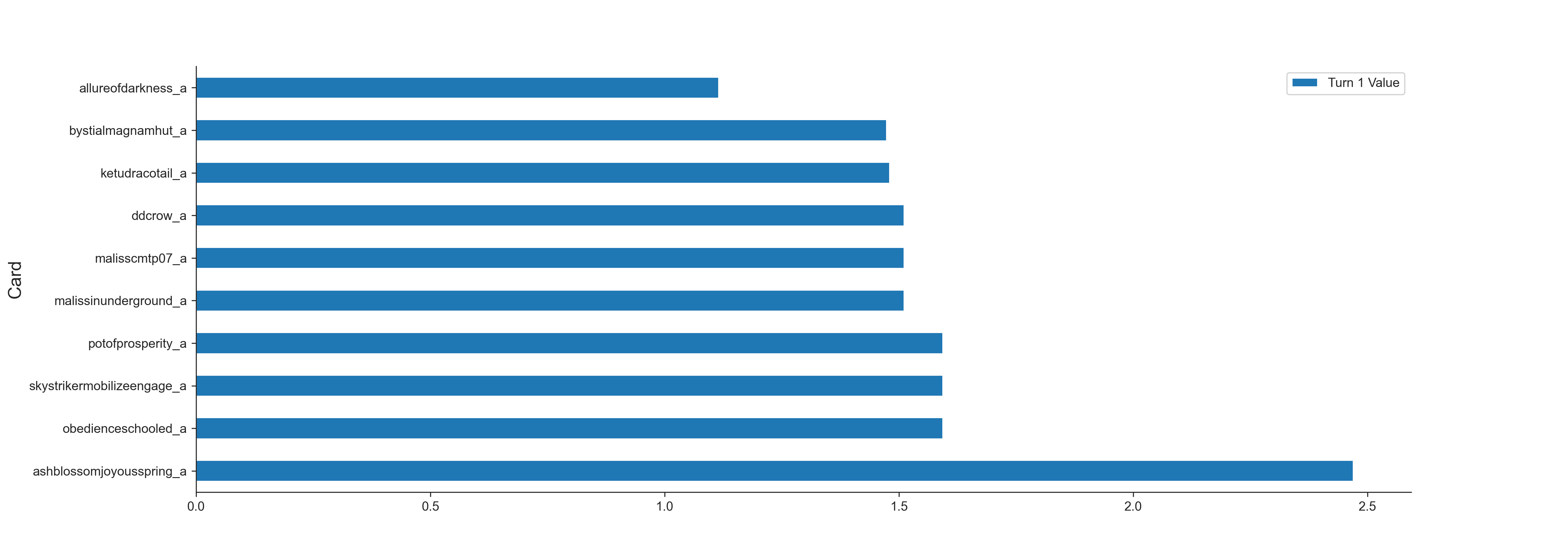
This shift is borne out in the data. Drawing Ash Blossom in your opening hand is worth a staggering 2.5 interruptions on average, as this amounts to the difference between a half-board and full-board setup. By the numbers, this is the single most valuable card you can draw going first according to our data.
The Data Points to Banlist Targets
Typically, when you test the validity of a statistical analysis method, you check if your models concur with some preexisting understanding about the system you’re analyzing. Since my dataset contains games played before the 09/15/25 banlist published by Konami, we can check whether banlist targets are indeed more valuable cards.
This initial hypothesis turned out to be true. The three most valuable (non-Ash Blossom) cards in our set are Pot of Prosperity, Sky Striker Mobilize Engage, and Obedience Schooled. Each is worth about an additional 1.5 interruptions if drawn in your opening hand going first. Pot of Prosperity is already limited to 1, Engage has been limited in the past, and Obedience Schooled was placed on the banlist less than a week after my data collection began.
Each of these cards has a powerful effect on an players endboard. Pot of Prosperity allows a player to draw a card of their choice from among the top 6 cards in their deck, while Engage allows a player to summon two monsters and potentially draw a card. Both cards give a player, especially one playing the Yummy deck which best uses the two Sky Striker monsters, the opportunity to play without having drawn the exact cards needed. Obedience Schooled takes this to another level, allowing a player to summon three Yummy monsters from the deck. Crucially, Yummy plays around the drawbacks of the card, allowing Obedience Schooled to summon three free monsters even without needing to draw them.
Edit 01/21/26 - Less than 48 hours after this article was published, Konami published an updated banlist for the competitive format. On it, Ketu Dracotail, the most powerful card in the Dracotail deck according to our calculations was limited to 1.
Conclusions
As a proof-of-concept, this analysis was very successful. With only a small sample of games, we were able to come to two reasonable conclusions. This suggests our methodology holds water and can be pursued further. Treating Ash Blossom as a going first card has been floated in the community multiple times, but these numbers show that Ash Blossom need not be a staple going first and going second. Second, being able to understand some modicum of the logic behind banlist decisions is huge for the community. Yu-Gi-Oh! banlists are released infrequently and often with minimal advanced notice, and anticipating hits using data-driven approaches rather than rules of thumb will allow competitive players to better prepare for changes.
This analysis is not without its limitations, though. The most glaring of the limitations is the small sample size, due my current data gathering procedures. In order to get the data for this analysis, I needed to personally sit down and take notes while watching replays. I took note of all the cards in each hand and counted every card each player had that could be activated on their opponent’s turn. In addition to being extremely time consuming, this procedure is also vulnerable to mistakes (such as a misspelling or miscounting). The biggest change that can be made to this project is a large data source and an automated system for ingesting the relevant data.
Many potential weaknesses of this style of analysis will hopefully solve themselves at scale. For example, consider a situation where a deck can set up numerous interruptions but these interruptions are ineffective against a certain other deck. Ryzeal Detonator would be classified as three interruptions, but destroying an on-field monster can be very weak against a deck like Yummy which plays by tributing monsters to the graveyard. With thousands of replays, you can expect these scenarios to play out numerous times and card values will even out.